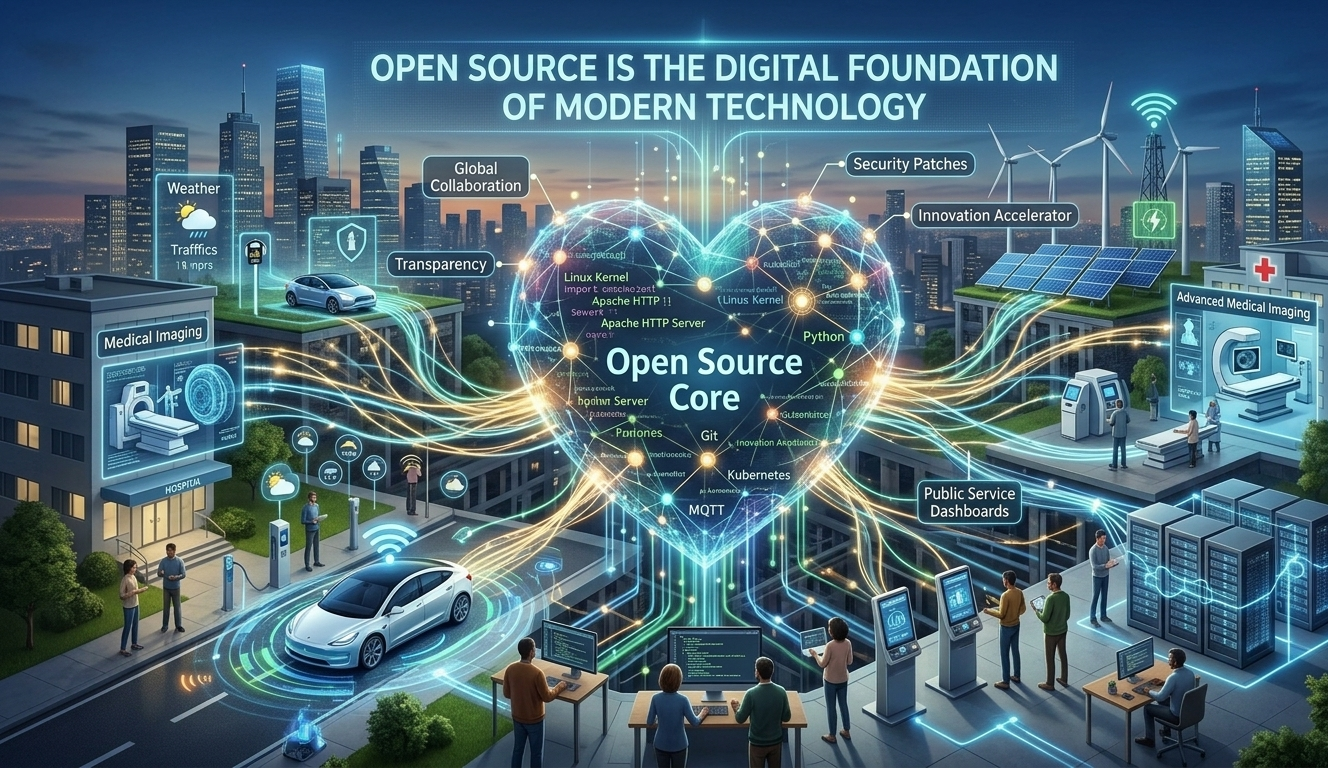
Many people use open-source software without realizing it.
They may interact with websites, applications, operating systems, development tools, or servers built partly with software whose source code is publicly available.
Open-source technology has played a major role in the growth of modern computing.
The basic idea is straightforward: software is made available under a license that allows people to inspect, modify, and often redistribute its source code according to the license terms.
This creates a different development model from traditional proprietary software.
Why Developers Like Open Source
Developers can examine existing projects instead of building everything from scratch.
Imagine a programmer creating a new application.
They may need a database system, web framework, image-processing library, or security component.
Rather than writing every component themselves, they can use established open-source projects where appropriate.
This can save enormous amounts of time.
Collaboration Makes Projects Stronger
Open-source projects often involve contributors from different countries and backgrounds.
One person may improve performance. Another may identify a bug. Someone else may improve documentation.
A successful project can benefit from thousands of contributions over time.
This does not mean every open-source project is automatically high quality.
Some projects are maintained actively, while others are abandoned.
Developers need to evaluate the project’s activity, documentation, security practices, and community before depending on it.
Open Source and Education
Open-source software is particularly valuable for students.
A student learning programming can inspect how real software works.
Instead of studying only theoretical examples, they can examine actual projects and experiment with code.
This can provide valuable practical experience.
Students can also contribute to projects and learn how professional software development works.
They may encounter version control, issue tracking, documentation, testing, and code reviews.
These skills are useful beyond the classroom.
Businesses Use Open Source Too
Businesses also rely heavily on open-source technologies.
Startups can use established software components without developing every tool internally.
This can reduce development time and allow teams to focus on their unique product.
Large companies also contribute to open-source projects.
They may release tools they have developed or support existing projects that are important to their operations.
This creates an interesting relationship between commercial businesses and community-driven development.
Security Questions
One common argument about open-source software is that publicly visible source code could make it easier for attackers to find vulnerabilities.
The reality is more complicated.
Public code can allow security researchers to inspect software and identify problems. At the same time, vulnerabilities can become visible to attackers as well.
The quality of security depends heavily on how actively a project is maintained.
Users should keep software updated and pay attention to security announcements.
Licensing Matters
Open source does not mean “no rules.”
Different open-source licenses have different requirements.
A developer or company planning to use open-source code commercially should understand the license conditions.
Ignoring licensing requirements can create legal and technical problems.
Fortunately, many projects provide clear licensing information.
The Role of Open Source in Innovation
Open-source software can accelerate innovation because developers can build on existing work.
One project may provide the foundation for another.
Over time, this creates layers of technology.
A developer does not necessarily need to reinvent basic components every time they build something new.
This is one reason modern software development can move so quickly.
Open Source Is Not Always Free of Cost
There is an important distinction between software being free to download and software being free to operate.
A business may use an open-source application without paying a licensing fee, but it may still need to pay developers, system administrators, hosting providers, security specialists, or support companies.
Running technology requires resources even when the software itself is freely available.
The Future of Open Source
Open-source development is likely to remain important as software becomes more complex.
AI tools, databases, programming languages, cybersecurity projects, developer platforms, and infrastructure technologies all benefit from collaborative development.
The model also provides opportunities for people who want to learn, contribute, and build technical reputations through real projects.
Final Thoughts
Open-source software is one of the quiet forces behind modern technology.
It encourages collaboration, gives developers access to useful tools, supports education, and allows businesses to build products faster.
But responsible use still matters.
Developers need to understand licensing. Organizations need to monitor security. Users need to keep important software updated.
Open source is not simply about getting software for free.
It is about sharing knowledge, building on existing work, and allowing technology to improve through collaboration.
Leave a Reply