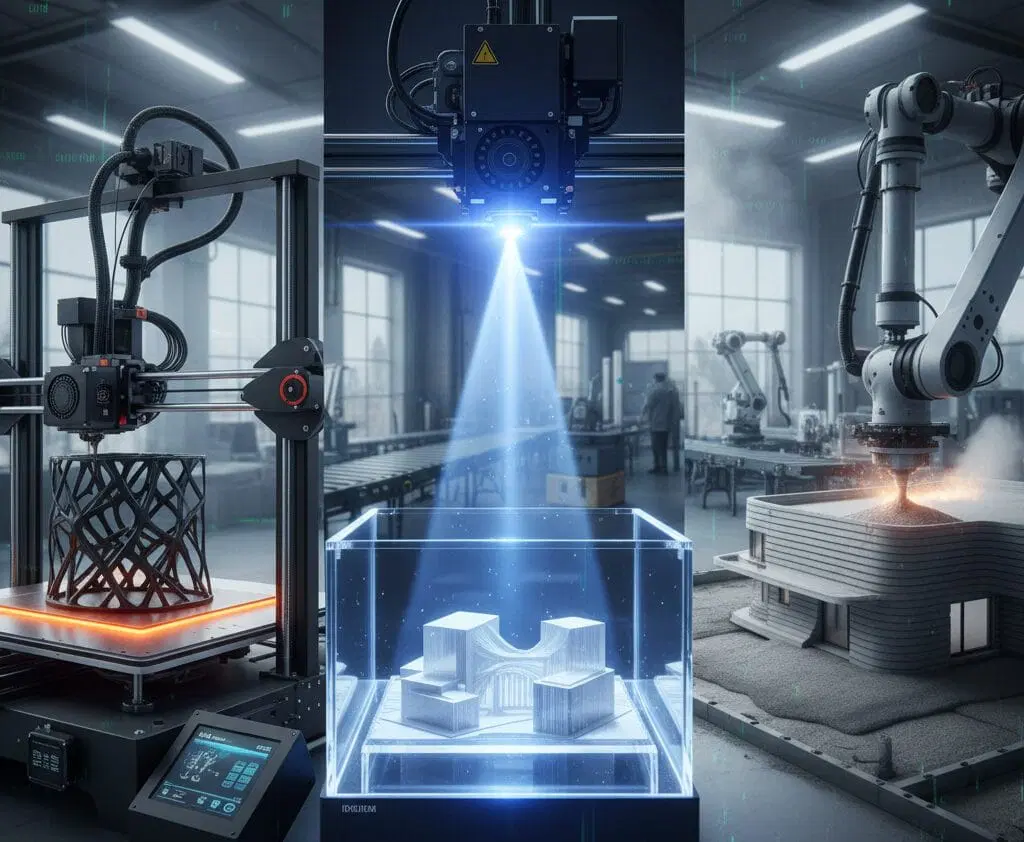
Manufacturing traditionally required specialized machines, factories, molds, and large production runs.
3D printing offers a different approach.
Instead of cutting material away or shaping it with traditional machinery, a 3D printer creates an object layer by layer from a digital design.
The technology has become more accessible over the years, and its applications now range from education and hobbies to engineering and manufacturing.
How 3D Printing Works
The process begins with a digital model.
The model is prepared using specialized software, which divides the design into layers.
The printer then creates the object one layer at a time.
Different printers use different materials and technologies.
Some use plastic filament. Others use resin, metal, or specialized materials.
The choice depends on what the finished product needs to do.
Rapid Prototyping
One of the most useful applications is prototyping.
Imagine an engineer designing a new product.
With traditional manufacturing, creating a physical prototype might require several days or weeks.
With 3D printing, the engineer may be able to create a basic prototype relatively quickly.
If the design does not work, it can be changed and printed again.
This allows designers to experiment.
Instead of trying to make the perfect product on the first attempt, they can create several versions and learn from each one.
Education and Student Projects
3D printers are also useful in schools and universities.
Students can design objects digitally and then turn those designs into physical models.
Engineering students can create mechanical components. Architecture students can produce building models. Design students can test product concepts.
This creates a connection between digital skills and physical making.
Students are not simply looking at a design on a screen. They can hold the result in their hands.
Custom Products
Traditional factories are usually most efficient when producing large quantities of identical products.
3D printing can be useful when only a small number of customized items are needed.
For example, a company may produce a specialized component for a particular machine.
Instead of manufacturing thousands of identical pieces, it may be possible to produce only the required quantity.
This can reduce waste in certain situations.
Healthcare Applications
Healthcare is another interesting area.
Researchers and manufacturers have explored 3D printing for models, customized equipment, prosthetic components, and other applications.
A customized physical model can help professionals understand complex structures before a procedure.
Some applications require extremely high standards and regulatory approval, so not every medical use is suitable for ordinary 3D printing.
Still, the technology has opened new possibilities.
Challenges of 3D Printing
3D printing is not a solution for every manufacturing problem.
Print speed can be slow for large objects.
Materials can also be expensive depending on the technology.
The printed object may require cleaning, finishing, or additional processing.
There are also limitations in strength, precision, and heat resistance depending on the material and printer.
Understanding these limitations is important.
The Environmental Question
3D printing can sometimes reduce material waste because objects are created using only the material required for the design.
However, that does not mean every 3D-printed product is automatically environmentally friendly.
Printers consume electricity, materials require production, and failed prints can become waste.
The environmental impact depends on the entire production process.
3D Printing at Home
Affordable desktop printers have made the technology accessible to hobbyists.
People can print storage organizers, replacement parts, decorative objects, educational models, and experimental designs.
This creates an interesting shift.
Instead of buying every small object, people can sometimes design or download a model and produce it themselves.
The biggest limitation is often imagination.
The Future of 3D Printing
The technology is likely to become more specialized.
Printers may become faster and more precise, while new materials could expand the range of possible applications.
Manufacturing may also become more localized.
Instead of shipping certain simple components across long distances, companies might produce them closer to where they are needed.
This could be particularly useful for remote locations or industries where replacement parts are difficult to obtain.
Final Thoughts
3D printing is not going to replace every traditional manufacturing method.
Instead, it provides another tool.
It is especially useful for prototypes, customized products, education, specialized components, and experimentation.
The biggest advantage may be the freedom to turn a digital idea into a physical object without requiring an entire factory.
That ability is changing how designers, engineers, students, and businesses think about making things.
The technology is still evolving, and its most interesting applications may be the ones that have not been invented yet.
Leave a Reply